





















Cuba needs help. For decades, it has been nearing complete economic collapse under a totalitarian communist government that has deprived its citizens of basic education, healthcare, food, and human necessities. Due to the political instability the United States put upon Venezuela after abducting President Maduro, Venezuela has been forced to stop funding Cuba. The effects are proven almost immediate. Cuba is now undergoing five to six blackouts a week due to a severe energy crisis, as opposed to their prior normality—one per week. While Cubans starve, President Donald Trump has come out to declare his passion: to finally “win the fight” and take over Cuba. However, in a world with constant international intervention and fruitless policies, U.S. intervention and aggression would do more harm than good to the already suffering country.
Instead of a comprehensive plan to restructure a nation that has been collapsing for decades, Trump hinges on one idea: remove the president, Miguel Diaz-Canel. This would fail to change the political structure of the country or even provide the U.S. with a political opening. Such a change would merely echo the failures of the United States’ operation in Venezuela, where Vice President Delcy Rodriguez swiftly replaced the abducted President Nicolas Maduro, and no political change was enacted.
In the 1950s, politician Fidel Castro led a revolution to overthrow the Cuban government with hollow promises of democracy and reform. Most Cubans, desperate for change from a dictatorial, corrupt president who repressed dissenters, supported the revolutionary struggle. When in power, however, Castro wasted no time establishing a totalitarian, one-party state that crushed dissent through executions, imprisonment, and forced exile. He militarized all of Cuban society and used firing squads to eliminate opposition. Economic deprivation and restriction of freedom birthed a fight for democracy and change, lasting decades. Thousands of Cubans, disillusioned and frightened of the new regime, risked their lives by fleeing Cuba to come to the United States.
The Trump Administration’s plan would remove the Cuban president, attempting to solve a problem with a solution of no substantial significance. The plan would amount to no effective political opening and weaken the likelihood that a more appropriate political opening could occur, progressing towards the democracy Cubans have been fighting for all their lives.
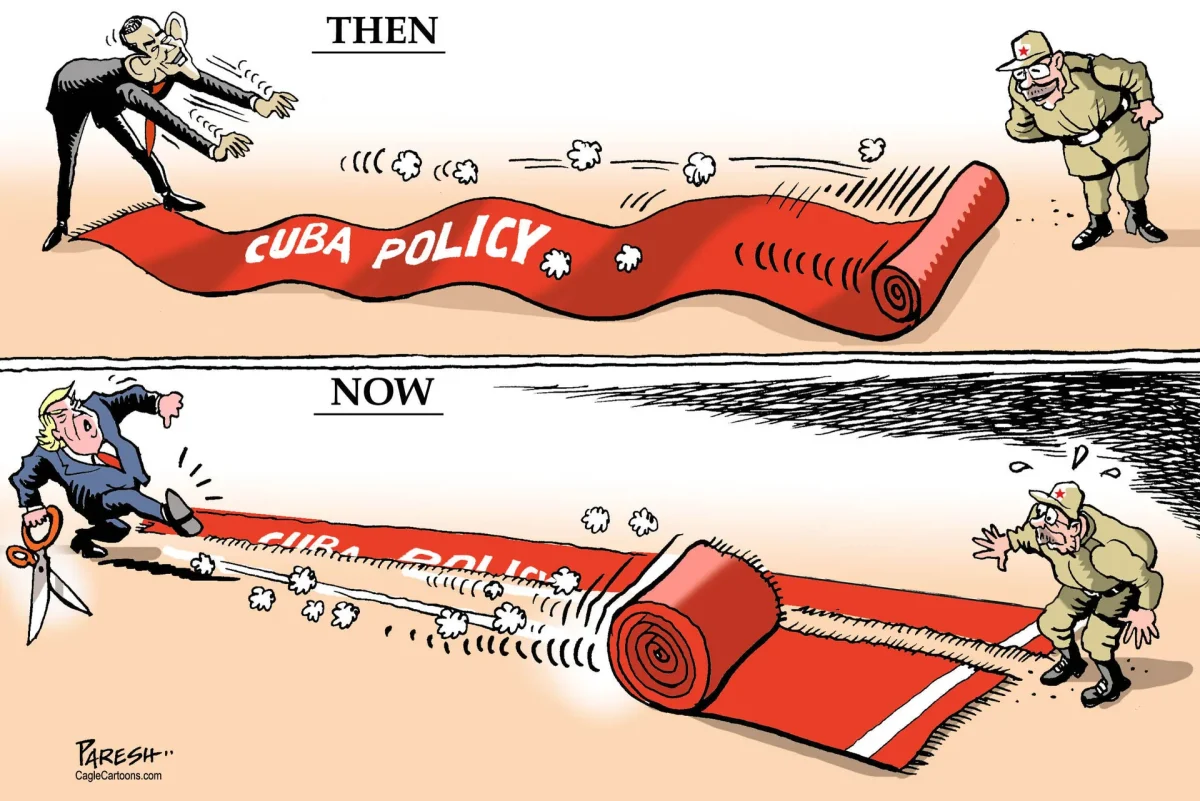
Over the past six decades, for example, U.S. presidents have promised and failed to return Cuba to a new democratic glory. Optimistic Cubans have expected to return to their country and are let down time and time again. Cuba’s communist regime continues to oppress the nation, and no American efforts have been made to change the fact. Despite his claim of a plan and willingness to use violence, there’s little reason to believe Trump’s promises are any less empty.
“The goal of presidential administrations in the United States since 1959 has been to change the regime of Cuba, since they decided that Castro was a threat. I think that would be their goal: to create a regime that’s more friendly. However, their intentions are really unclear,” said Dr. Sribnick, a social studies teacher. “My sense is that it’s less about Trump’s desire and more about Marco Rubio, the Secretary of State. I think that this has been a long desire of his coming from the Cuban community that he would love to say he accomplished.”
Recent events have brought many to believe that the Cuban government will humbly submit to attempts made by the United States to topple the regime and institute political change. Such shifts will catalyze the release of several political prisoners and allow investment from the United States. However, these are superficial gestures. To institute any real difference, these investments would need to come with mandated political reform. Those reforms, evidently, are dependent on the true goal of the United States. But a good start would be the demilitarization of the country’s economic management. It would be tricky to manage and likely unsuccessful to a certain extent, highlighting the complexity and futility of a situation in which the U.S. were to get involved in Cuba.
Considering President Trump has not stated a goal to democratize the island, he and his administration should stay out. Risking the country’s political and social future is not worth a brief moment of triumph, as Trump has showcased with other nations. Cubans need one thing in the face of crisis: an improved political situation where basic necessities and food are an enforced human right, not a privilege.