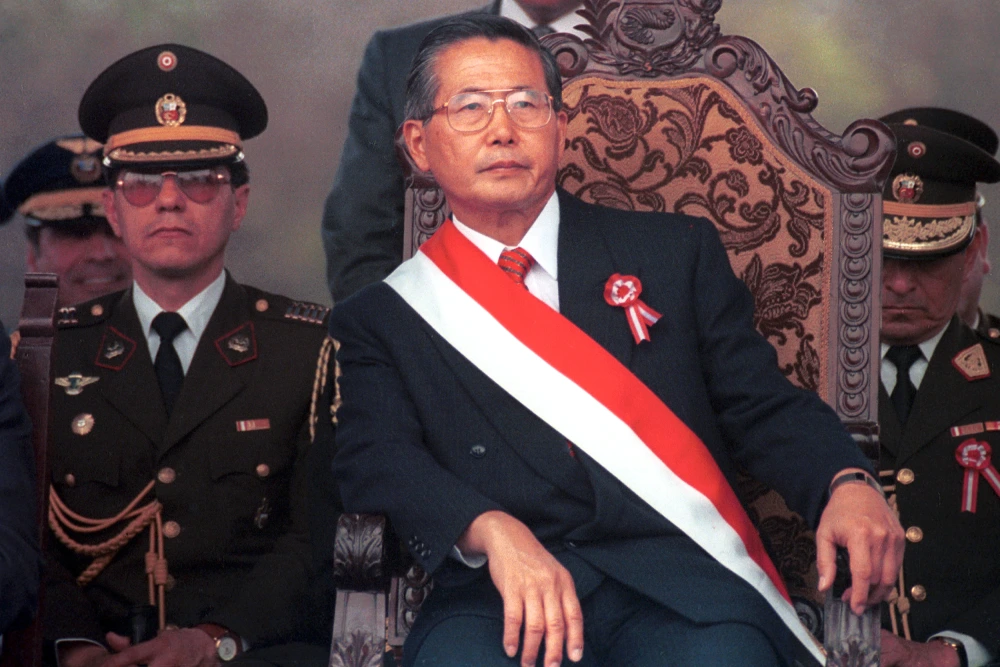
Alberto Fujimori conducted a hostile takeover of the Peruvian government after a surprising election win in 1990. While he was credited for stabilizing the economy, his administration was mostly defined by significant human rights abuses, authoritarianism, and systemic corruption. Among his abuses of power, he authorized the unlawful execution of military groups, university students, and coerced thousands of Indigenous Peruvian women into sterilization between 1996 and 2000. Though this was branded as an “anti-poverty” campaign, it was obvious to large swaths of the public that this was an attempt to ethnically cleanse the country of its indigenous population. In 2009, years after his presidency concluded, Fujimori was finally sentenced to twenty-five years in prison for charges of human rights abuses. He was released in 2023 and passed away the following year due to tongue cancer.
Current standings: Alberto Fujimori’s legacy is incredibly fragmented for the reasons mentioned. However, he has maintained the support of many right-wing conservatives, wealthy business elites, and some of the rural, uneducated population. As of now, Keiko Fujimori, his daughter, has run in four presidential elections and, with the support of the remaining Fujimoristas, hopes to snag a win one day and reestablish a dictatorship akin to that of her father. She has consistently lost in national elections and has established herself to many in Peru as the country’s biggest political loser.
Shaping Peru’s politics: Systemic corruption defines Peru’s current political system. An unstable and institutional design that combines a weak presidency with a fragmented Congress enables a constant loop of political shakedown. It’s not about who’s best for the country; it’s about who can extract the most money through coercion, with the end goal of securing a presidential position. In Peru, the people directly elect both the head of state and the country’s legislature, with the president serving a 5-year term. The hyper-fragmented and dominant Congress in Peru can remove the president at will using a very vague impeachment clause.
Therefore, the President of Peru is fundamentally weak, as seen in the fact that Peru has had eight presidents in the last decade. Despite these weaknesses, the president in power continues to exert sizable influence, legally or not, over the country he rules. As long as the leader can remain on good terms with the members of the legislature, the position has become exceptionally powerful and dangerous.
Where Peru is headed: On June 7th, a runoff between Roberto Sanchez and Keiko Fujimori will occur, and the president will be decided. Roberto Sanchez is an extremist left-wing politician seeking to follow in Pedro Castillo’s footsteps of economic instability. He currently serves as a Congressman and held the position of Minister of Foreign Trade under former President Pedro Castillo. Keiko Fujimori, as previously mentioned, is the daughter of dictator Alberto Fujimori and seeks to follow in her father’s footsteps of corruption and a complete lack of freedom of speech. While both candidates are extremely unfit and keep corrupt cabinets, their willingness to play the game of bribes and extortion has enabled them to reach the top. The consequences of either candidate will be reflected on different levels in different groups. If Sanchez wins, the economy will become incredibly unstable. The working class and indigenous communities will suffer through unfulfilled promises, and public institutions will be forced to grapple with widespread corruption. If Keiko Fujimori wins, undocumented migrants will face mass deportation and profiling, rural and indigenous communities will be alienated from the voting processes, indigenous communities will lose their land and water, and human rights advocates will be silenced. The next administration will, ineluctably, bring about political chaos to the Peruvian people.